
on Posted on Reading Time: 5 minutes

Enterprises embarking on an AI training journey are also embarking on a data transfer journey on a vast scale. Attempting to move petabytes or exabytes of data at yesterday’s bandwidth speeds will be painfully slow and expensive.
In our Analyst Insights series, Omdia’s Ian Redpath explores direct, scale optical connectivity between millions of enterprise sites and their AI partners as an incredible asset. Pairing the optical underlay with the agility demanded by the temporal AI environment will be the kinetic differentiator.
The solution is an upgrade in accessing bandwidth to key enterprise sites, housing their data, paired with network-as-a-service (NaaS)-based flexibility. Mplify is taking multiple initiatives to support the enterprise access bandwidth uplift:
- Defining wavelength payloads for Mplify certified wavelength services.
- Defining 100G Carrier Ethernet with an AI profile.
- Defining an orchestration layer turning static capacity into programmable, federated resources.
The recipe for success is taking shape. The physical network is a differentiator. Direct, scale optical connectivity between millions of enterprise sites and their AI partners is an incredible asset. Pairing the optical underlay with the agility demanded by the temporal AI environment will be the kinetic differentiator.
Enterprise AI Training = Petabytes/Exabytes of Data Transfer
The Enterprise Connectivity Challenge
Enterprises have lakes and oceans of data, potentially residing in many different locations and on many different modern and legacy platforms. A comprehensive AI journey could potentially begin with a comprehensive IT strategic review. One outcome of the migration to a next-generation IT stance will be choosing the optimal locations for corporate data.
Dave Ward, former-CPTO, Lumen: “Moving the data into the AI training data centers is a bottleneck. As the enterprises work through their AI and cloud strategy—their data strategy— the need for a refreshed network strategy becomes apparent.”
Enterprises Will Demand Flexibility and Choice, Not Lock-In
Enterprises will desire a flexible AI environment:
- Enterprises will want to be able to choose the optimal large language model (LLM) for their specific needs.
- Enterprises will want the flexibility to work with multiple LLM providers and not be locked into a one-supplier ecosystem.
- Enterprises will invest time and resources to “clean up” their data to ready it for model training.
The Enterprise Connectivity Cost for Moving AI Training Data
There is a cost to moving training data slowly. The AI cloud providers’ charging structure has a time-based component. AI cloud providers will begin charging as data begins to enter their environment. At low speeds, transferring enormous data sets will take time—a lot of chargeable time. Faster transfer speeds will reduce the costs incurred by the enterprises.
At Mplify’s GNE 2025, Lumen presented the cost implications for lower-speed data transfer. Moving 1 Petabyte of data will take days via a 10Gbps link. Stepping up to a 100G or a 400G link will reduce the transfer time to hours with substantial cost savings.
Why Now? Bandwidth is essential for efficient enterprise AI
Enterprise networks now move petabyte and even exabyte sized data sets.
At that scale, the network sets training time and cost.
GPU cluster rental costs are ~$2K/hour.
Moving 1 petabyte of data over a 10G connection takes 222 hrs vs 6 hrs on 400G.
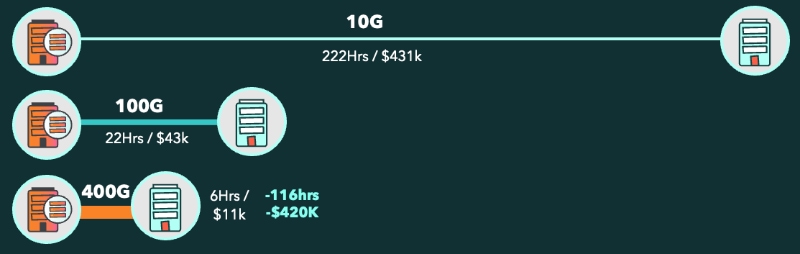
Figure 1: Higher Capacity Links Enable Lower Training Costs (Source: Lumen)
Summary of New Enterprise Requirements for the AI Era
Summary of new enterprise requirements in an AI environment:
- Greater bandwidth, particularly from sites housing vast corporate datasets: 100G/400G access.
- Performance expectations are also increasing. Enterprises have become much more sensitive to latency, and desire network latency statistics on primary and secondary routes.
- Network robustness: fully diverse or “tri-verse” routes, potentially mesh for uptime.
- Enhanced agility: APIs enabled to allow flexible activation of network resources.
- Enhanced visibility into key network parameters to enable predictive operations.
The Solution: Scale, Flexible Bandwidth, Matching Needs
Application requirements and bandwidth requirements will never fit within precise compartments; it is always a continuum. For the highest capacity AI training needs, full wavelengths may be the optimal fit for the job. For Enterprises with more modest AI training needs, AI model tuning or AI inferencing, 100G Carrier Ethernet with an AI profile may be the right size.
Enabling Wavelength Scale and Standardization for Federation
To realize the AI promise, the entire optical underlay needs to be scaled. From wavelength-based enterprise access, through the AI-middle mile, and onto the AI factories. Wavelengths, 100G, 400G, 800G, and beyond are emerging as the new network currency. No one carrier or AI provider has ubiquitous worldwide coverage. Historic 1G/10G services required standardization to enable automated intercarrier federation. Wavelengths will require standardization for federation as well.
Mplify Initiatives for 100G/400G/800G Wavelength Payloads
Mplify is working with members to define wavelength payloads for Layer 1 services, enabling dynamic capacity management, pre-provisioned activation, and federated lifecycle orchestration. Along with published standards, this work will establish the foundation for certified wavelength services that deliver deterministic, high-capacity transport between enterprises, cloud/AI data centers, and distributed model training sites.
100G Carrier Ethernet with an AI Profile
The industry is transitioning from a 1G/10G to a 100G as-a-service era. In addition, AI is necessitating a performance step-up beyond the capacity step-up. The AI profile will include:
- Symmetrical, committed bandwidth with ultra-low latency: 3ms frame delay
- Jitter: 1ms frame delay variation
- Frame loss: ≤0.001%
- Uptime: ≥99.999%
Mplify Initiatives for Carrier Ethernet with an AI Profile
Mplify is evolving the Carrier Ethernet lifecycle automation by focusing on:
- On-demand provisioning.
- Dynamic scaling.
- And federated assurance across providers.
Carrier Ethernet’s global ENNI fabric provides an immediately available foundation for linking data centers, edges, and enterprise sites, combining predictable latency, guaranteed throughput, and class-of-service control critical to continuous inference and coordination loops. With interconnections ranging from 10G to 400G, Carrier Ethernet is well-positioned to meet a multitude of AI demands.
The Underpinning Network and Management Environment Must Evolve to Intersect AI Demands
Optical Networks Must Continue Scale in a Timely and Targeted Manner
Grand ambitions must navigate capex constraint realities, but scale is a must. Many service providers are intimately involved in AI data center infrastructure build roadmaps. The premium value will be for the initial low-latency partners, followed by the wave of diversity partners. Long tail partners will see residual value.
Enterprise access will be another highly prized asset. Direct fiber-based connectivity to high-value enterprise clients will attract the market.
Advanced Control with Agile, Programmable, API-enabled Networks
Enterprises want AI training choice, not lock-in. Additionally, AI training is episodic. Enterprises do not require capacity all the time, but desire tremendous capacity for specific projects.
- Programmable fabrics to be enabled: DCI-centric, on-demand connectivity flexes with AI workloads through self-serve, secure, zero-touch platforms.
- Customer experience must be digitized: From static catalogs, manual provisioning to API marketplaces, self-serve fabrics, click-to-buy, and zero-touch turn-up.
Learn More
- To learn more about Omdia’s coverage areas, visit Omdia.tech.informa.com.
- Download the Mplify Market Brief: NaaS: The Automated Network Supply Chain for Agentic AI.
- Learn more about Mplify’s vision for NaaS.
- Read the Mplify NaaS Industry Blueprint.