
on Posted on Reading Time: 4 minutes
There is a major industry shift from traditional machine learning and generative AI toward agentic AI, where swarms of AI agents collaborate, orchestrate workflows, and operate continuously across digital environments. This evolution fundamentally changes network requirements, demanding infrastructure that is secure, automated, elastic, programmable, and capable of delivering high performance at scale.
With trillions of dollars being invested in GPUs, data centers, and power systems, AI infrastructure is entering a new phase of global expansion, spanning hyperscale data centers and national digital sovereignty initiatives. As this buildout accelerates, one reality is becoming increasingly clear: connectivity is emerging as the decisive bottleneck and the greatest strategic opportunity in the AI era.
AI is no longer confined to single prompts and static responses. As the industry enters the Agentic AI era, intelligence shifts from isolated models to persistent, distributed systems that reason continuously, coordinate workflows, and take autonomous action across cloud, edge, and national infrastructures. In the Agentic AI era, intelligence production requires federated connectivity ecosystems, not isolated provider networks. Agentic AI requires a deterministic, programmable, on-demand fabric with lifecycle automation across providers.
In Mplify’s recent market brief, “NaaS: The Automated Network Supply Chain for Agentic AI,” we highlight how this reality gives rise to Network-as-a-Service (NaaS) for AI—an operating model purpose-built to deliver the performance, automation, security, and scale that agentic systems demand. NaaS is no longer just an operational abstraction; it is the infrastructure fabric that enables AI to function at global scale.
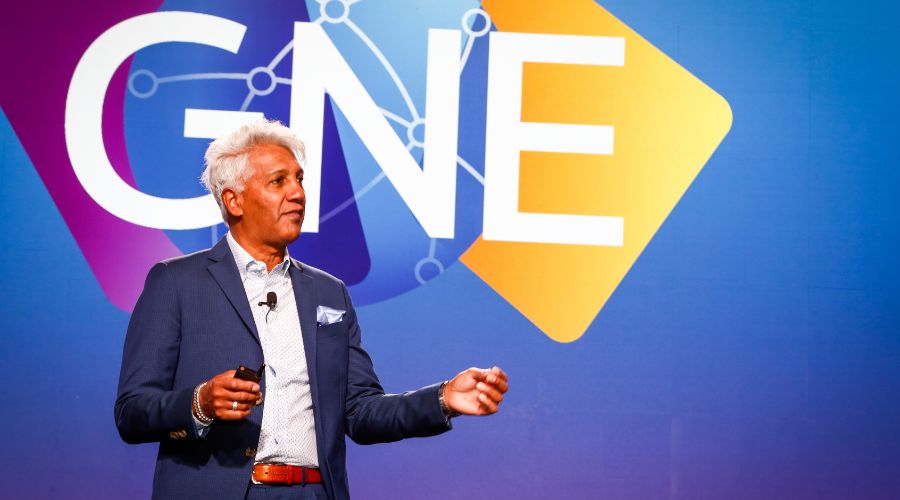
At Mplify’s Global NaaS Event (GNE)in November 2025, I shared a roadmap to guide Mplify and its members through this transformation—a practical, standards-driven path to making NaaS the infrastructure foundation for the Agentic AI era. It is built around four strategic pillars: connectivity for AI, automation for AI, cybersecurity for AI, and revenue services for AI. Together, these pillars define how networks must evolve to become AI-native and how service providers can position themselves at the center of the multi-trillion-dollar AI infrastructure buildout.
Short Term: Connectivity for AI
The first and most immediate requirement for AI is transport. Connectivity is the toll bridge for AI. It is the foundational layer that enables everything else. AI models must continuously synchronize, replicate, and move large volumes of data across distributed infrastructure. That places wavelengths, Carrier Ethernet, and on-demand connectivity at the center of the AI equation.
Each transport technology plays a distinct and complementary role. Wavelengths are ideal for synchronizing massive foundational models across hyperscale data centers, offering deterministic performance at extreme speeds. Carrier Ethernet, on the other hand, provides global reach, flexibility, and cost efficiency for enterprise AI, including private training environments and regional data center interconnect.
At the same time, AI models must connect to the “eyes and ears” of the system, such as the devices, sensors, users, and edge environments. That makes model-to-peripheral connectivity just as critical as data center interconnect.
Moving into 2026, Mplify is focused on:
- Modernizing Carrier Ethernet and wavelength services specifically for AI workloads.
- Launching a new Carrier Ethernet Certification for AI, with stricter performance and determinism requirements.
- Enabling AI connectivity through NaaS building blocks such as IP broadband, DIA, Carrier Ethernet over broadband, and access technologies spanning fiber, 5G, and satellite.
This transport layer ensures that AI models can train, synchronize, and infer reliably anywhere across the digital ecosystem and at scale.
Automation for AI
Connectivity alone is not enough. AI cannot operate on static, manually configured networks. Automation is what allows networks to adapt, scale, and respond in real time. For more than a decade, Mplify has focused on automating east-west orchestration across the service provider and wholesale ecosystem. That work has paid off. Our APIs now support the full-service lifecycle and provide interoperability across providers from quoting and ordering to assurance, fault management, and billing.
AI agents and models will not integrate individual APIs. Instead, networks must expose their capabilities through standardized wrappers using the Model Context Protocol (MCP). This allows agents to automatically discover, understand, and invoke network functions without robust, point-to-point integrations.
To make this possible, Mplify is:
- Converting LSO APIs into MCP friendly APIs.
- Packaging all standards, schemas, and payloads into AI-friendly JSON resources.
- Developing MCP reference frameworks so members can rapidly implement compliant environments.
- Preparing next-generation certification for payloads, methods, and domain-specific languages (DSLs).
Think of APIs as transport mechanisms and payloads as the language AI systems actually speak. By standardizing those payloads, we make NaaS natively consumable by AI agents. The result is a programmable, self-adapting network that AI systems can interact with directly.
Mid Term: Cybersecurity for AI
AI introduces entirely new security challenges. Models and agents are not passive software. They make decisions, interact autonomously, and can carry embedded threats. Traditional security approaches are no longer sufficient.
Networks must be able to accurately classify AI workloads so that security and governance policies can be enforced correctly. They must also authenticate and authorize AI agents and models—not just users and devices—while inspecting models and agents for embedded threats in much the same way software is scanned today. Finally, networks need the ability to dynamically segment and contain misbehaving agents before they can cause broader, systemic damage across the environment.
In parallel, quantum-safe networking is becoming non-negotiable. Post-quantum cryptography will be mandatory across interconnects as quantum computing renders today’s encryption ineffective. Mplify is actively working on standards to ensure quantum-safe security across Ethernet, optical transport, and network-to-network interfaces.
Long Term: Revenue Services for AI
The most transformative opportunity ahead is Sovereign AI. For the first time, governments around the world are turning to service and network providers and saying: You are our national AI infrastructure. They are funding GPU capacity, model development, and AI data centers at unprecedented scale.
This creates two massive opportunities:
- GPU-as-a-Service, enabling sovereign training and inference within national borders.
- Model-as-a-Service, where countries develop AI models tailored to their languages, regulations, and use cases.
Mplify will support this shift by defining NaaS standards for GPU-as-a-Service (training and inference), Model-as-a-Service, Edge and regional AI deployments, and standardized GPU attributes, capabilities, and DSLs. This is where transport, automation, cybersecurity, and compute converge into a complete NaaS-for-AI ecosystem.
The Future of NaaS Is AI-First
We are not building AI for networks. We are building networks for AI. By modernizing transport, transforming automation, strengthening cybersecurity, and enabling sovereign AI, Mplify is equipping its members to lead in the AI era. The roadmap is clear. The opportunity is massive. And the time to act is now.
Learn More
- Get Mplify’s 2025 Market Brief: NaaS for Agentic AI.
- Listen to Pascal’s GNE 2025 keynote as well as all other sessions.
- Download the Mplify NaaS Customer Experience White Paper.
- Learn more about Mplify’s vision for NaaS.
- Read the Mplify NaaS Industry Blueprint.

Pascal Menezes
Chief Technology Officer | MEF