
on Posted on Reading Time: 3 minutes
For a customer buying network services, the promise of NaaS is straightforward: get the services you need, when you need them, with less effort. Delivering that experience across providers is harder. A fast quote still needs to become a working service, advanced capabilities need to be easy to buy, and partners need to coordinate the delivery.
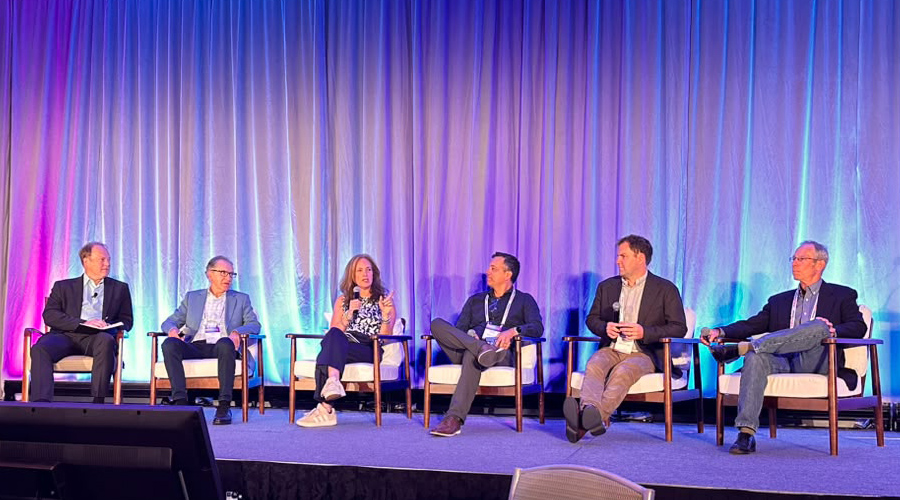
Those challenges ran through the analyst discussion at the Mplify Member Summit – Americas in Boston September 2026. Moderated by Mplify Principal Analyst Stan Hubbard, the session brought together analysts to consider what the day’s presentations meant for providers and enterprise customers. Five short excerpts explore the opportunities they see in AI infrastructure, the obstacles to automation, and the role federation can play in bringing services together.
What’s Holding Back Network Automation?
Automating discovery, qualification, ordering, and assurance can improve how providers transact with one another. Those processes also depend on the operational systems and networks that fulfill the request. Appledore Research’s Grant Lenahan identifies that connection as a frequent point of failure: automation reaches an existing operations support system, and the path down to the network becomes more difficult.
His observation explains why progress can be uneven. Providers have substantial investments in systems introduced at different times, supplied by different vendors, or developed internally. Aligning service information and processes across that infrastructure takes sustained work. For providers planning their next automation investment, the question is how reliably an automated transaction carries through to service delivery.
Watch: What’s Holding Back Network Automation?
The Opportunity in Connecting AI Infrastructure
AI infrastructure gives connectivity providers new environments to connect, including enterprises, data centers, and GPU services. Atlantic-ACM’s Charlie Reed sees an opportunity in the private links that a more distributed AI ecosystem may require, while acknowledging that the market is still developing.
Capturing that opportunity depends partly on how quickly providers can respond. Reed’s comments on provisioning and communication between carriers connect the AI opportunity to practical improvements in service delivery. Providers need to be able to quote, provision, and coordinate with partners as customer requirements change. Connectivity expertise and complementary partnerships will help determine where they can participate.
Watch: The Opportunity in Connecting AI Infrastructure
Making NaaS Simple and Repeatable
As NaaS expands to include more security and AI-related capabilities, providers face a commercial challenge: explaining what customers can buy and making it easy to adopt. Dell’Oro Group’s Mauricio Sanchez describes an industry at a crossroads, exploring services that go beyond on-demand connectivity while still needing a clear proposition for enterprises.
Sanchez’s emphasis on simplicity and repeatability gives providers a useful test for new offerings. Customers need to understand the service, how it addresses their requirements, and how they will use it. Repeatable offers also give providers a more practical route from individual deployments to broader adoption. The value of a sophisticated service depends on making it understandable and manageable for the customer.
Watch: Making NaaS Simple and Repeatable
Federation: From Concept to Industry Direction
Vertical Systems Group’s Erin Dunne noticed a change in the federation discussion between two summits. Earlier conversations had spent considerable time defining a federated network or ecosystem. In Boston, she heard a shared understanding of the concept and why it was needed.
That is a useful sign of alignment, though it does not mean the implementation work is complete. A common understanding gives participants a basis for addressing the details of collaboration: finding suitable partners, establishing trust, and making services work across organizational boundaries. Dunne’s observation captures progress in the industry’s willingness to work through those requirements together.
Watch: Federation: From Concept to Industry Direction
How Federation Can Simplify Service Delivery
The customer experience provides another way to assess federation’s value. An enterprise operating across multiple locations may need services from several providers, each with its own coverage and capabilities. Appledore Research’s Grant Lenahan explores how bringing those partners and services together can simplify buying and delivery.
His comments connect federation to a practical business objective: giving customers clearer service choices while making implementation more manageable for the providers involved. That requires agreement on how services are described and combined, as well as coordination between partners. For enterprises, the benefit is an easier way to obtain services across a distributed footprint.
Watch: How Federation Can Simplify Service Delivery
Turning Industry Direction into Customer Experience
Across the five clips, the analysts return to the work required to make NaaS useful at scale. AI creates opportunities for connectivity providers, but pursuing them requires services customers can understand, automation that reaches the network, and partners that can deliver together.
These perspectives help explain the business relevance of Mplify’s work on NaaS for AI, Agentic LSO, and NaaS Federation. The priorities address connected parts of the same challenge: defining the services customers need, automating their lifecycle, and supporting collaboration across providers.
Watch the view the full analyst discussion for more perspectives from Boston.
Learn More
- Hear Stan Hubbard and leading analysts discuss NaaS State of the Industry
- Read the analyst reports from Mplify Member Summit – Americas 2026
- “The Autonomy Iceberg Beneath Ecosystem Automation” by Grant Lenahan of Appledore Research
- “The NaaS Paradox: Simpler Enterprise Networks Require a More Connected Industry” by Mauricio Sanchez of Dell’Oro Group
- “Recap of Mplify Member Summit Americas” by Greg Bryan of TeleGeography
- Listen to Mplify CTO Pascal Menezes’ strategic vision for the AI era.
- View all presentations and recordings from the Mplify Member Summit – Americas.