

on Posted on Reading Time: 5 minutes
Artificial Intelligence is transforming how digital infrastructure is built, operated, and consumed. It is changing what enterprises, developers and digital platforms need from connectivity. As AI becomes embedded across every industry, communications networks must evolve from programmable connectivity to intelligent platforms capable of supporting autonomous, real-time decision making. Increasingly autonomous AI agents will continuously request, negotiate, provision, optimize, and secure connectivity across mobile, fixed, cloud, and edge environments.
This shift requires more than faster networks. It requires a programmable network with common, open and interoperable, way for applications, enterprises and service providers to operate in an intelligent connectivity ecosystem where network capabilities can be securely discovered, orchestrated, and consumed regardless of the underlying technology or provider.
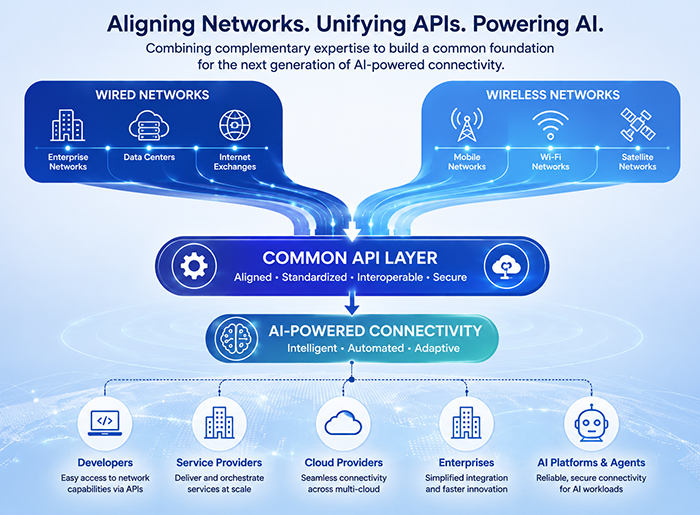
To accelerate this transition, Mplify Alliance and GSMA have partnered to align network APIs across wired and wireless domains, combining their complementary expertise to establish a common foundation for the next generation of AI-powered connectivity.
By bringing together the GSMA Open Gateway framework and Mplify’s Lifecycle Service Orchestration (LSO) APIs and Network-as-a-Service (NaaS) initiatives, the collaboration is helping simplify how developers, enterprises, service providers, cloud providers, and AI platforms interact with network capabilities across the global digital ecosystem.
A Shared Vision for the Future
Today’s developers increasingly expect networks to behave like cloud platforms—programmable, automated, and available on demand. Enterprises want connectivity that can adapt to changing business requirements, support distributed workloads and deliver consistent performance across multiple domains.
Tomorrow, AI Agents will expect even more. Future applications will need to coordinate data, compute and connectivity in real time, often across mobile, fixed, cloud, edge and inter-provider environments. No single network domain can meet these requirements alone.
Rather than simply invoking individual APIs, AI Agents will intelligently discover network capabilities, reason across multiple providers, negotiate service requirements, orchestrate resources, and continuously optimize connectivity to achieve business objectives.This evolution represents a shift from exposing network functions to enabling intelligent, outcome-driven connectivity.
That is why collaboration between GSMA Open Gateway and Mplify is important. It helps the industry move from fragmented API exposure toward a more consistent, interoperable model for accessing and orchestrating network capabilities across the wider digital infrastructure ecosystem.
Complementary Strengths, One Open Ecosystem
The collaboration brings together two complementary industry initiatives.
GSMA Open Gateway provides a globally aligned framework for exposing standardized mobile network capabilities through common APIs, , developed in cooperation with the Linux Foundation CAMARA project ,enabling developers and enterprises to integrate advanced network functions into their applications with greater consistency and scale.
Mplify extends this vision across fixed, optical, cloud, edge, and inter-provider environments through its Lifecycle Service Orchestration (LSO) framework and comprehensive portfolio of Business and Operational APIs, enabling end-to-end service lifecycle automation across the broader connectivity ecosystem.
These complementary capabilities help create a unified connectivity platform where applications—and increasingly AI Agents—can interact seamlessly with networks across technologies, providers, and geographic boundaries. The result is greater consistency for developers and enterprises and a more interoperable foundation for service providers building AI-ready digital infrastructure.
As AI workloads increasingly span mobile, fixed, cloud, edge, and inter-provider environments, no single network domain can support them alone. Aligning complementary frameworks across these domains creates a more consistent and interoperable foundation for AI-ready services, an approach demonstrated through the Quality on Demand collaboration between Mplify, GSMA, Colt, and Orange. In the demonstration, applications dynamically requested and adjusted network performance across wired and wireless environments using standardized APIs.
Accelerating the AI Era
As AI adoption accelerates, networks must evolve beyond programmable infrastructure into intelligent platforms capable of supporting autonomous decision-making and real-time adaptation. AI-ready infrastructure will require networks that can respond to business intent rather than static configuration, coordinating resources dynamically across multiple domains.
To help accelerate this transformation, Mplify has launched its Network-as-a-Service (NaaS) for AI initiative, evolving its industry-leading LSO framework toward Agentic LSO—the next generation of service orchestration designed specifically for the AI era.
Building upon the open connectivity foundation established through the GSMA Open Gateway collaboration, Agentic LSO enables AI Agents to securely discover, reason over, orchestrate, and continuously optimize services throughout the complete service lifecycle.
This evolution extends automation beyond traditional system-to-system integrations, enabling AI-native orchestration across business processes, operational workflows, and multi-provider service delivery.
Together, the GSMA Open Gateway framework and Mplify’s NaaS for AI initiative establish a practical roadmap for evolving programmable networks into intelligent, interoperable and AI-ready connectivity platforms.
Delivering Business Outcomes
The goal is not simply to expose more APIs. It is to make network capabilities easier to consume, combine and orchestrate in support of real business outcomes.
For example, an AI-enabled manufacturing application could request low-latency connectivity for a robotics process, validate device and location context through mobile network APIs, and coordinate service assurance across fixed, mobile and edge domains.
Similarly, an AI application could dynamically coordinate cloud compute resources with connectivity across multiple service providers, continuously optimizing latency and performance as workloads shift between regions.
In this model, applications and AI-enabled systems increasingly express business intent rather than detailed technical network instructions.
Examples include:
- Deliver guaranteed application performance.
- Reduce end-to-end latency below a specified threshold.
- Dynamically optimize connectivity for AI workloads.
- Secure communications for mission-critical services.
- Increase resilience during periods of congestion.
- Balance performance, availability, sustainability, and cost.
The underlying connectivity platform will intelligently coordinate capabilities across mobile, fixed, cloud, and edge networks to satisfy those objectives through open, standards-based interfaces.
What This Means for the Industry
The collaboration creates practical benefits for multiple stakeholders across the digital infrastructure ecosystem.
For service providers, it supports greater automation, improved inter-provider interoperability and new opportunities to expose and monetise network capabilities through standardised APIs.
For developers, it provides a more consistent way to access network capabilities across operators, domains and geographies, reducing fragmentation and simplifying integration.
For enterprises, it enables more adaptive, secure and resilient connectivity for distributed applications, AI workloads and mission-critical digital services.
For cloud, edge and AI platforms, it creates a foundation for programmable connectivity that can be coordinated with compute, data and application services.
Across all of these audiences, the value lies in creating a common framework that makes connectivity easier to discover, consume, assure and optimise across the full service lifecycle.
By combining complementary capabilities, the collaboration creates practical benefits for communications service providers, developers, enterprises, and the broader digital infrastructure ecosystem.
Unified Network APIs. Aligning wired and wireless API frameworks to simplify application development and enable more consistent network orchestration.
Cross-Domain Interoperability. Connecting mobile, fixed, cloud, edge, and enterprise environments through open standards and interoperable APIs.
Intelligent Connectivity. Enabling Quality on Demand, adaptive performance, automated assurance, and policy-driven optimization for AI-powered applications and AI Agents.
Accelerated Innovation. Providing developers, enterprises, operators, hyperscalers, and ecosystem partners with a common platform for next-generation digital services.
AI-Ready Digital Infrastructure. Creating the intelligent connectivity foundation required to support autonomous operations and the AI economy.
Looking Ahead
The communications industry is entering a new era.
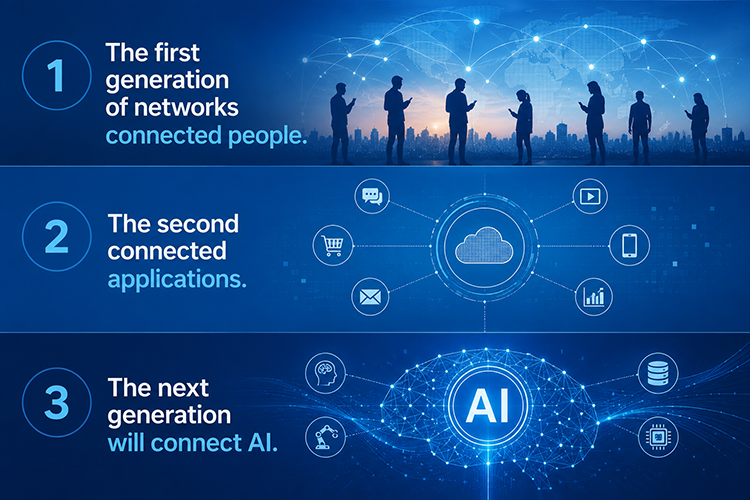
The first generation of networks connected people.
The second connected applications.
The next generation will connect AI.
GSMA and Mplify share a common vision of an open, interoperable, AI-ready connectivity ecosystem where standardized network capabilities enable innovation across the global communications industry.
Through the combination of the GSMA Open Gateway framework and Mplify’s NaaS for AI initiative, the collaboration is helping evolve today’s programmable networks into tomorrow’s intelligent, agent-driven connectivity platform.
Together, GSMA and Mplify are laying the foundation for a more open next generation and trusted digital infrastructure—one where AI Agents, applications, enterprises, and networks collaborate seamlessly to deliver autonomous, secure, and high-performance connected experiences for the AI economy.
Learn More
- Learn more about the Mplify Alliance and GSMA partnership.
- See how Mplify is evolving its industry leading Lifecycle Service Orchestration framework.
- Read the latest press release on the Mplify Alliance and GSMA partnership, Mplify Joins GSMA Open Gateway Framework to Advance Unified Network APIs Across Wired and Wireless Domains for AI-Powered Connectivity.

Pascal Menezes
Chief Technology Officer | Mplify