

on Posted on Reading Time: 5 minutes
We are entering a new phase of transformation, where the role of the network is being fundamentally redefined.
As AI systems evolve from static models to agent-based architectures, a new interaction model is taking hold across software, cloud, and network environments. In this, systems no longer rely solely on predefined workflows or human-triggered automation. Instead, they operate through continuous coordination, making decisions and executing actions in real time.
At the center of this shift is Model Context Protocol (MCP), which is quickly emerging as a standard for how AI agents interact with tools, services, and infrastructure. For networking, this is a meaningful change. MCP introduces an approach where agents can discover, invoke, and coordinate capabilities dynamically, based on context and intent rather than rigid integration logic. This goes beyond incremental improvement to APIs and changes how networks are accessed, how services are delivered, and how ecosystems operate.
APIs Evolve in the Age of AI
For years, APIs have been the foundation of network automation. They have enabled standardization, streamlined operations, and made it possible to integrate services across systems and providers.
That foundation does not change. It becomes even more important.
What is changing is how those APIs are used.
In traditional environments, APIs are typically invoked through predefined workflows, where the sequence of actions and conditions are explicitly defined. This works well in stable, predictable scenarios.
In AI-driven environments, however, conditions are more dynamic. Systems need to respond in real time, adapt to changing inputs, and coordinate across domains without relying on rigid, preconfigured logic.
This is where MCP extends the value of APIs.
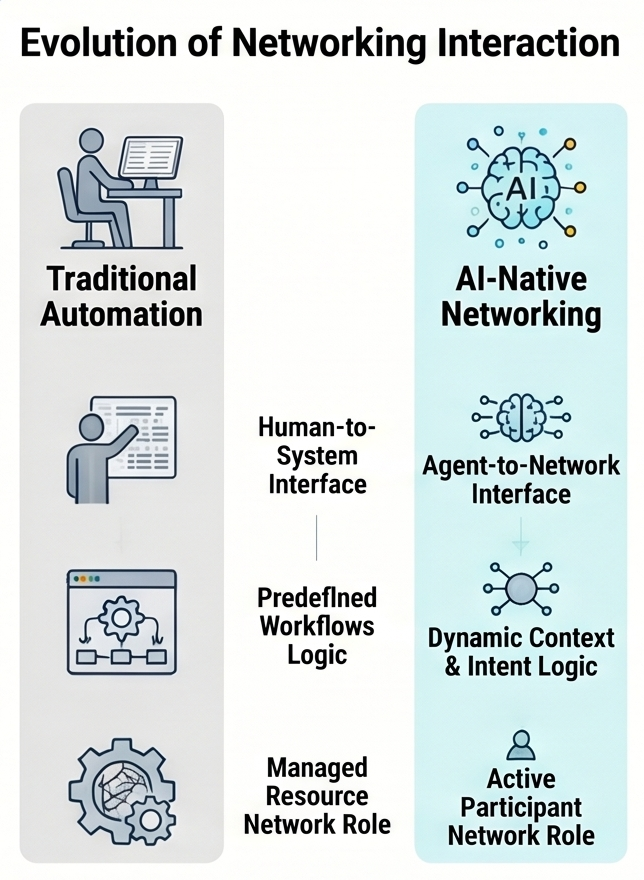
Rather than replacing APIs, MCP introduces a new interaction model that allows AI agents to work with them more effectively. Through MCP, agents can:
- Discover available network capabilities exposed through APIs
- Interpret context and determine appropriate actions
- Invoke and coordinate API-driven workflows dynamically
This shifts the interface from strictly human-to-system to increasingly agent-to-network, while still relying on the same standardized API foundation. The result is APIs that are more accessible, adaptive, and scalable in AI-native environments, transformed from static integration points into interfaces that AI systems can actively consume.
The network moves from a managed resource to an active participant in the system.
From Passive Infrastructure to Real-Time Control Plane
One of the clearest signals of this shift is how networks are now used in real-world scenarios.
At MWC26 Barcelona, Mplify and its partners Colt Technology Services, Orange, Google Cloud, GSMA Open Gateway, DENSO and Tata Elxsi demonstrated how agentic AI and standardized APIs can orchestrate communication quality across wireless and wired networks in real time. The use case focused on connected vehicles and autonomous systems, where performance requirements are not just high, but variable and unpredictable.
In this environment, the network cannot remain static. It must continuously adapt to support:
- Safety-critical coordination between vehicles
- Real-time telemetry and data exchange
- Over-the-air updates and software-driven features
- Low-latency control for autonomous systems
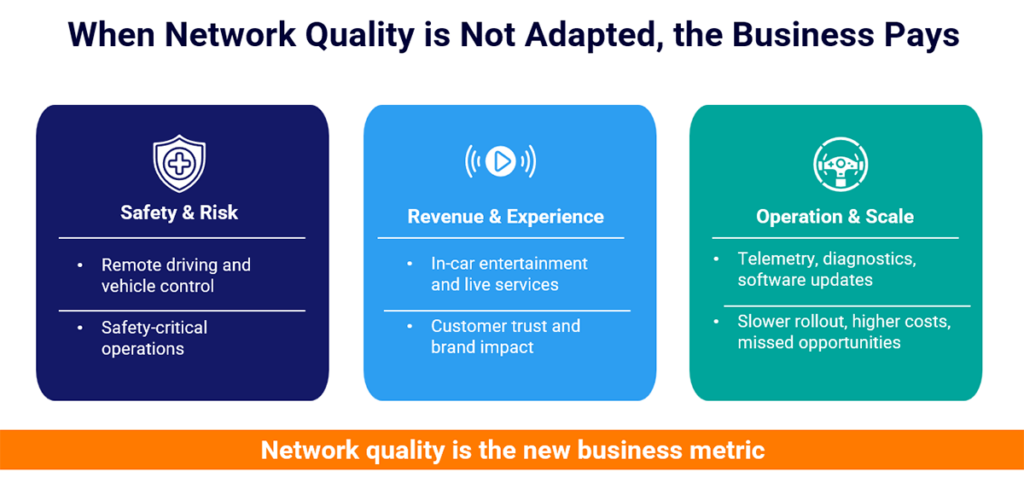
Using agentic AI, applications can request Quality on Demand, adjust connectivity parameters, and coordinate across domains without manual intervention.
This is a fundamentally different model. The network is no longer just transporting data. It is interpreting intent and responding in real time.
And this extends well beyond mobility.
AI workloads distributed across cloud and edge environments require dynamic bandwidth allocation, latency management, and service assurance. Multi-provider enterprise services require coordination across domains that cannot be managed through static integrations. Even operational processes like fault management and service modification are becoming candidates for autonomous execution.
Across these scenarios, the pattern is the same: the network must observe, decide, and act.
LSO as the Foundation for AI-Native Networking
This is where Mplify’s Lifecycle Service Orchestration (LSO) framework becomes critical.
LSO APIs provide the standardized foundation that makes this level of coordination possible. They define how services are ordered, provisioned, monitored, and managed across providers and domains. Without this layer of standardization, agent-based interaction would quickly become fragmented and unscalable.
The Kylie SDK release builds directly on this foundation by introducing MCP support across the LSO API portfolio. This enables AI agents and large language models to interact directly with network infrastructure through standardized interfaces, bridging the gap between intent-driven systems and operational execution.
Importantly, this focuses on making APIs usable in AI-native environments, not just exposing them.
The LSO API Blending Tool allows providers to combine LSO APIs with product-specific schemas, including IP, Carrier Ethernet, and emerging services like data center interconnect and Quality on Demand. With MCP support introduced in the Kylie release, these can now be converted into MCP-compatible interfaces that AI agents can discover and use.
This creates a consistent, scalable model for how networks integrate into AI-driven systems. LSO provides the structure. MCP defines the interaction model. Together, they enable a new level of automation and interoperability across the ecosystem.
A Shift in Competitive Advantage
This transition has both technical and strategic implications.
As AI-driven services scale, the ability to deliver predictable, adaptable connectivity becomes a differentiator. Service providers are no longer competing solely on coverage or capacity. They are competing on how effectively their networks can integrate into automated, multi-domain environments.
In this context, three capabilities stand out:
- Interoperability at scale: The ability to operate seamlessly across providers, cloud platforms, and edge environments
- Automation readiness: The ability to expose services in a way that supports agent-based interaction
- Ecosystem participation: The ability to collaborate within a standardized, API-driven framework
Providers that align with these capabilities will be positioned to support the next generation of services. Those that do not risk becoming disconnected from increasingly automated service chains.
Mplify’s Role in What Comes Next
Mplify’s direction is focused on enabling this transition across the industry.
Through LSO APIs, we have established the foundation for standardized, multi-domain orchestration. With the introduction of MCP through the Kylie release, that foundation is now being extended into AI-native interaction models.
At the same time, Mplify continues to bring the ecosystem together through collaboration with organizations such as GSMA and CAMARA, ensuring alignment across network domains and accelerating adoption of open, interoperable frameworks.
This is not just about standards. It is about defining how APIs, data models, AI systems, and ecosystems converge to support the next generation of connectivity.
Looking ahead, this work will continue to evolve. Future releases will expand AI-driven capabilities, introduce new assets, and further simplify how providers integrate into intelligent, automated ecosystems.
My belief is that the providers who move early on this and make their networks genuinely legible to AI systems, will define what the next layer of digital infrastructure looks like.
The Network’s New Role in the AI Economy
The implications of this shift are clear.
Networks are no longer passive infrastructure. They are becoming active, intelligent participants in how digital services are delivered.
This requires a change in how the industry thinks about connectivity. It is no longer just about moving data. It is about enabling systems to act.
MCP and LSO together provide a path forward. One defines how systems interact, and the other ensures those interactions are standardized, interoperable, and scalable.
For an industry built on connectivity, this is the next logical step.
The network is no longer just part of the system. It is now part of the decision-making process.
Learn More
- See the recent MWC26 Barcelona press release, Mplify, Colt, Orange, Google Cloud, and GSMA Open Gateway Demonstrate Agentic Connected Experiences at MWC26 Barcelona.
- Explore the GSMA Open Gateway case study: Keeping vehicles connected to critical services.
- Download the Mplify Market Brief: NaaS: The Automated Network Supply Chain for Agentic AI.
- Learn more about Mplify’s vision for NaaS.
- View the Agentic Connected Experience | Colt video on YouTube.
- Read the Mplify NaaS Industry Blueprint.

Pascal Menezes
Chief Technology Officer | Mplify